Free PDF Quiz 2026 Juniper JN0-481 Marvelous Exam Dump
Wiki Article
P.S. Free & New JN0-481 dumps are available on Google Drive shared by Real4test: https://drive.google.com/open?id=1yI9HuvIQjvOL1lTZCNiAX63QUUgbmYUI
You can trust the JN0-481 practice test and start this journey with complete peace of mind and satisfaction. The JN0-481 exam PDF questions will not assist you in Data Center, Specialist (JNCIS-DC) (JN0-481) exam preparation but also provide you with in-depth knowledge about the Data Center, Specialist (JNCIS-DC) (JN0-481) exam topics. This knowledge will be helpful to you in your professional life. So Data Center, Specialist (JNCIS-DC) (JN0-481) exam questions are the ideal study material for quick Juniper JN0-481 exam preparation.
Juniper JN0-481 Exam Syllabus Topics:
| Topic | Details |
|---|---|
| Topic 1 |
|
| Topic 2 |
|
| Topic 3 |
|
| Topic 4 |
|
| Topic 5 |
|
JN0-481 Free Exam & JN0-481 Practice Test Engine
When they will be giving their final examination to get Juniper JN0-481 certification they don't struggle much and do it easily. The results of the customizable JN0-481 exam dumps can then be used to identify areas of strength and weakness and to create a personalized study plan that focuses on improving in the areas that need the most work. Taking JN0-481 Practice Tests regularly could help individuals build their confidence, reduce test anxiety, and improve their overall performance.
Juniper Data Center, Specialist (JNCIS-DC) Sample Questions (Q20-Q25):
NEW QUESTION # 20
Which type of generic system should you select when adding a new server inside an existing rack type?
- A. Rack generic
- B. Embedded generic
- C. Internal generic
- D. External generic
Answer: C
Explanation:
In Apstra 5.1, servers that connect to leaf switches are represented as generic systems so Apstra can model links, apply connectivity templates, attach virtual networks, and validate intent. The selection of generic system type depends on whether the endpoint is considered part of the rack's internal topology or an external attachment. When you add a new server inside an existing rack type, that server is treated as a component of the rack topology (that is, it lives "within" the rack alongside leaf switches and any other rack-internal endpoints). Apstra documentation refers to such systems as internal generic systems.
Internal generic systems are not managed like switches (no full device management), but they are first-class topology objects: they occupy ports on leaf switches, can be tagged with roles, and can be associated with link definitions that drive correct interface intent (LAG vs single link, VLAN tagging, and virtual network association). This modeling is essential in EVPN-VXLAN fabrics because correct endpoint attachment on leaf ports determines VLAN/VNI mapping and the resulting Junos v24.4 configuration rendered by Apstra.
External generic systems, by contrast, represent devices outside the rack topology (often used for external routers, firewalls, or other non-rack-contained endpoints). Because the question explicitly places the server inside an existing rack type, the correct choice is Internal generic.
Verified Juniper sources (URLs):
https://www.juniper.net/documentation/us/en/software/apstra5.1/apstra-user-guide/topics/topic-map/internal-generic-system-create.html
NEW QUESTION # 21
Which of the following two statements are correct?
- A. VXLAN encapsulation discards VNIs
- B. VXLAN is a Layer 2 encapsulation protocol
- C. VXLAN is a Layer 3 encapsulation protocol
- D. VXLAN encapsulation discards VLAN IDs
Answer: B,D
NEW QUESTION # 22
Which two statements are correct about a Juniper Apstra server? (Choose two.)
- A. The Juniper Apstra server requires one network adapter connection for each managed device.
- B. The Juniper Apstra server requires a single network adapter.
- C. The Juniper Apstra server uses Layer 3 to communicate with managed devices.
- D. The Juniper Apstra server uses Layer 2 to communicate with managed devices.
Answer: B,C
Explanation:
Apstra manages devices using IP connectivity over the management network, which is a Layer 3 relationship. Whether you are using on-box agents or off-box agents, the controller (or cluster) communicates with the fabric devices using IP reachability (for example, to exchange management traffic, retrieve discovery state, collect telemetry, and push configuration). This is why Layer 2 adjacency is not required between the Apstra server and the managed switches; the essential requirement is routable IP connectivity and appropriate access (credentials/agent connectivity) to the device management interfaces.
From a platform perspective, Apstra does not need a dedicated physical NIC per managed device. Instead, the server/VM requires connectivity to the management network through a single network adapter, and that interface can route to all managed devices. In a typical data center deployment, the Apstra controller VM sits on a management VLAN/subnet and reaches the entire fabric through routed management. This scales operationally: adding devices does not require adding additional server NICs; it only requires IP reachability and capacity planning for telemetry and agent workloads. Thus, the correct statements are that Apstra uses Layer 3 to communicate with managed devices and that it requires a single network adapter for that management connectivity model.
NEW QUESTION # 23
In the Juniper Apstra design phase, which object dictates port count, port speed, and how the ports would be used?
- A. interface map
- B. rack type
- C. logical devices
- D. network devices
Answer: A
Explanation:
Interface maps are objects that map interfaces between logical devices and physical hardware devices in the Juniper Apstra design phase. They dictate port count, port speed, and how the ports would be used for achieving the intended network configuration rendering. Interface maps also allow you to select device ports, transformations, and interfaces, provision breakout ports, and disable unused ports.
NEW QUESTION # 24
You are attempting to attach the server connected to the my_border_001_leaf1 node's ge-0/0/5 interface to the finance-app virtual network.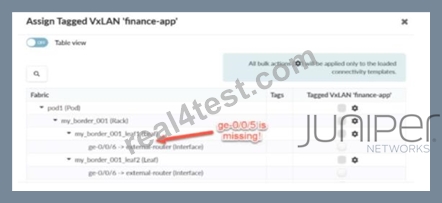
Referring to the exhibit, what would you do to solve the problem?
- A. You can set the generic system to the deploy mode.
- B. You can add a generic system to the physical topology.
- C. You can assign the finance-app virtual network to the my_border_001_leaf1 node.
- D. You can allocate an IP pool resource to the virtual network.
Answer: B
Explanation:
In Apstra 5.1, servers are modeled as Generic Systems and must be represented in the blueprint topology so that Apstra can bind an endpoint (the server) to a specific switch interface and then apply the intended connectivity template / virtual network attachment. In the exhibit, the interface ge-0/0/5 on my_border_001_leaf1 is shown as missing from the assignment workflow, which indicates that Apstra does not currently have an endpoint object connected to that port in the blueprint's staged physical topology (or that the port is not presented as an eligible connectivity point for server attachment).
The correct remediation is to add a Generic System connected to my_border_001_leaf1 ge-0/0/5 in Staged > Physical > Topology, thereby creating a modeled server link on that interface. Once the Generic System exists and the interface is a recognized server-facing connectivity point, you can assign the Tagged VXLAN "finance-app" connectivity template (or the VN assignment action driven by that template) to the server-facing interface and then commit the staged changes.
Changing "deploy mode" may affect whether Apstra actively configures a generic system-facing link, but it does not solve a missing interface in the topology model. Likewise, allocating an IP pool is unrelated to making the port available for attachment, and assigning the VN to the switch node is not how server interfaces are attached in this workflow.
Verified Juniper sources (URLs):
https://www.juniper.net/documentation/us/en/software/apstra5.1/apstra-user-guide/topics/topic-map/internal-generic-system-create.html
https://www.juniper.net/documentation/us/en/software/apstra5.0/apstra-user-guide/topics/topic-map/virtual-network-assignment-update.html
https://cloudlabs.apstra.com/labguide/Cloudlabs/6.0.0/test-drive-guide/lab1-junos-11_adding-gs.html
NEW QUESTION # 25
......
If you want to pass your JN0-481 exam, we believe that our learning engine will be your indispensable choices. More and more people have bought our JN0-481 guide questions in the past years. These people who used our products have thought highly of our JN0-481 Study Materials. If you decide to buy our products and tale it seriously consideration, we can make sure that it will be very easy for you to simply pass your exam and get the JN0-481 certification in a short time.
JN0-481 Free Exam: https://www.real4test.com/JN0-481_real-exam.html
- Reliable JN0-481 Exam Question ???? Pdf JN0-481 Torrent ???? JN0-481 Free Brain Dumps ???? Go to website ➡ www.pdfdumps.com ️⬅️ open and search for 《 JN0-481 》 to download for free ????Test JN0-481 Question
- JN0-481 Actual copyright ???? Certification JN0-481 Sample Questions ???? JN0-481 Valid Exam Papers ???? Easily obtain free download of ➥ JN0-481 ???? by searching on ➤ www.pdfvce.com ⮘ ????Reliable JN0-481 Exam Question
- Updated Juniper JN0-481 Questions - Effortless Solution To Pass Exam ???? Easily obtain ➠ JN0-481 ???? for free download through “ www.exam4labs.com ” ????Certification JN0-481 Sample Questions
- Certification JN0-481 Sample Questions ???? Reliable JN0-481 Exam Question ???? Test JN0-481 Dumps Pdf ☕ Search for ⏩ JN0-481 ⏪ and easily obtain a free download on ➡ www.pdfvce.com ️⬅️ ????Valid JN0-481 Test Dumps
- JN0-481 Updated Torrent - JN0-481 Valid Practice - JN0-481 Test Engine ???? Simply search for ▛ JN0-481 ▟ for free download on ⏩ www.examcollectionpass.com ⏪ ????Exam Sample JN0-481 Online
- Hot Exam JN0-481 Dump – The Best Free Exam for JN0-481 - Efficient JN0-481 Practice Test Engine ‼ Go to website { www.pdfvce.com } open and search for ➤ JN0-481 ⮘ to download for free ????JN0-481 Free Brain Dumps
- Updated Juniper JN0-481 Questions - Effortless Solution To Pass Exam ⤵ Search for “ JN0-481 ” and obtain a free download on ➤ www.examcollectionpass.com ⮘ ⤵Relevant JN0-481 Questions
- Pdf JN0-481 Torrent ⏪ JN0-481 Questions Answers ???? JN0-481 Valid Test Question ???? Search for ⇛ JN0-481 ⇚ and obtain a free download on ▶ www.pdfvce.com ◀ ????Valid JN0-481 Test Dumps
- JN0-481 Exam copyright Materials are the Most Excellent Path for You to pass JN0-481 Exam - www.exam4labs.com ???? Easily obtain free download of 【 JN0-481 】 by searching on “ www.exam4labs.com ” ????JN0-481 Free Exam
- Test JN0-481 Question ???? Exam Sample JN0-481 Online ???? JN0-481 Free Exam ???? Open ⇛ www.pdfvce.com ⇚ and search for ▛ JN0-481 ▟ to download exam materials for free ↙JN0-481 Actual copyright
- Test JN0-481 Dumps Pdf ???? JN0-481 Free Exam ☮ Valid JN0-481 Exam Question ???? Search for ☀ JN0-481 ️☀️ and download it for free on 「 www.pdfdumps.com 」 website ????Reliable JN0-481 Dumps Free
- bushrabgww064959.kylieblog.com, electricallearningportal.com, umairgiuv585678.blogs100.com, fortunetelleroracle.com, barrygaxh655719.atualblog.com, nicolaszjjm047281.creacionblog.com, caoimhelkhi611293.bloggosite.com, sachinpgjv652754.national-wiki.com, omegaglobeacademy.com, amieussl902675.blogsvirals.com, Disposable vapes
P.S. Free 2026 Juniper JN0-481 dumps are available on Google Drive shared by Real4test: https://drive.google.com/open?id=1yI9HuvIQjvOL1lTZCNiAX63QUUgbmYUI
Report this wiki page